
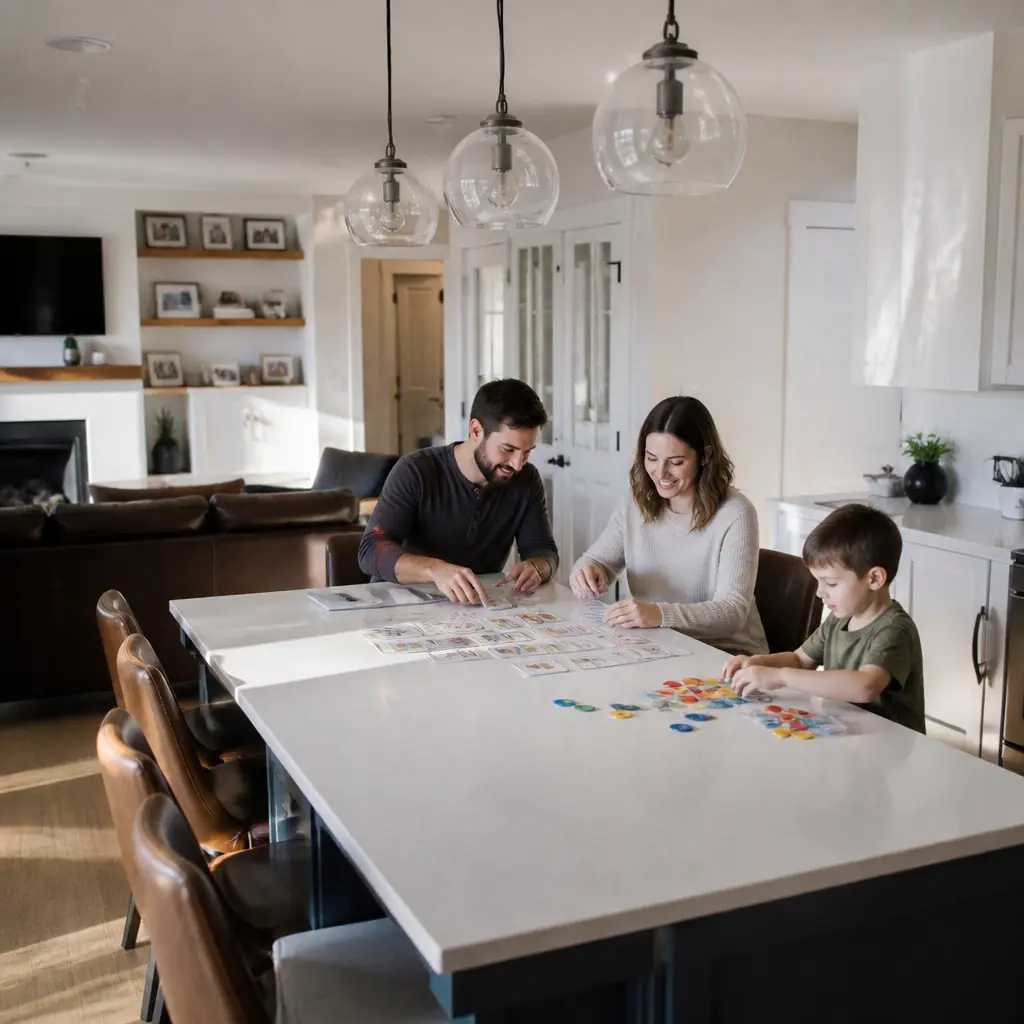
A family vibe is the shared emotional tone, routines, language, and values that shape everyday life at home. The most polished version is not strict uniformity: it combines a child’s emerging preferences with Mom’s and Dad’s strengths through clear expectations, warmth, flexibility, and consistent repair after conflict. This approach matters as parenting pressure rises—Pew Research Center reported in 2023 that 62% of U.S. parents considered parenting harder than it was 20 years earlier, while the U.S. Surgeon General’s 2024 advisory found that 33% of parents experienced high stress in the previous month compared with 20% of other adults. A unified family vibe can reduce avoidable friction by aligning household values, dividing parental roles intentionally, and giving children a dependable sense of belonging.
Family Vibe as a Unified Parenting Style
Family vibe as a unified parenting style is a practical framework in which caregivers coordinate their expectations, emotional responses, communication habits, and routines while preserving individual personalities. It is not a formal clinical diagnosis or a single theory recognized by psychology. Instead, it brings together established ideas from authoritative parenting, positive parenting, family systems theory, and collaborative problem-solving.
Developmental psychologist Diana Baumrind described authoritative parenting as a combination of high responsiveness and appropriately firm demands. Later work by Eleanor Maccoby and John Martin distinguished authoritative parenting from authoritarian, permissive, and neglectful patterns. A polished family vibe generally aims for the authoritative middle ground: adults remain warm and attentive, children have meaningful voice, and boundaries remain understandable and enforceable.
Authoritative family vibe
An authoritative family vibe pairs connection with structure. Mom and Dad may use different tones—one more playful and one more direct—but they agree on the essential message: feelings are welcome, harmful behavior is not, and limits are predictable. The American Academy of Pediatrics describes positive discipline as teaching appropriate behavior rather than relying on punishment, humiliation, or physical force.
This style is especially useful for recurring moments such as bedtime, screen transitions, homework, sibling conflict, and public behavior. The family does not need identical scripts. It needs shared principles, such as “we speak respectfully,” “we repair when we hurt someone,” and “we finish essential responsibilities before optional entertainment.”
Complementary parent styles
Complementary parenting means that caregivers contribute different strengths without turning those differences into competition. One parent may excel at emotional naming, while the other is skilled at logistics, physical play, humor, or follow-through. Children can benefit from this variety when the differences are coordinated rather than contradictory.
The risk appears when complementary becomes divided or polarized—for example, one parent is always the comforter and the other is always the enforcer. That arrangement can create resentment between adults and teach children to seek one parent as an escape from the other. A stronger pattern is rotating responsibilities and allowing both parents to practice warmth, authority, listening, and limit-setting.
Child-inclusive family vibe
A child-inclusive family vibe treats children as participants in family life without making them responsible for adult decisions. Children can help choose weekend activities, propose solutions to routine problems, select between acceptable options, and contribute to family rituals. This approach connects with the United Nations Convention on the Rights of the Child principle that children should have opportunities to express views on matters affecting them, with those views considered according to age and maturity.
Child inclusion is not permissiveness. A preschooler might choose between two pajamas, an elementary-age child might help design a morning checklist, and a teenager might negotiate a reasonable phone boundary. The adults retain responsibility for safety, health, development, and final decisions when values or risks are involved.
Family Vibe as Coordinated Household Culture
Once the parenting styles are understood, the next step is to convert them into a household culture. Family culture is built through repeated signals: how people greet one another, handle mistakes, distribute work, celebrate milestones, and respond under stress. The goal is not a staged or image-conscious home. “Polished” means coherent, intentional, and resilient enough to function on ordinary difficult days.
Shared family values
Shared values are the small set of principles that guide decisions when parents disagree. Useful examples include kindness, honesty, responsibility, curiosity, health, faith, creativity, independence, and service. Families should define each value behaviorally. “Respect” might mean no name-calling, knocking before entering a room, and listening without interrupting; “responsibility” might mean returning belongings and acknowledging mistakes.
A short family values statement is more useful than an elaborate mission statement. Parents can ask: What do we want our children to feel at home? How should we respond when someone fails? Which rules are safety-based, which are preference-based, and which can be negotiated? These questions prevent minor style differences from becoming major arguments.
Aligned routines and rituals
Routines reduce the number of decisions a family must make while tired or rushed. The Centers for Disease Control and Prevention identifies positive parenting practices—such as predictable responses, clear communication, and attention to children’s needs—as important supports for healthy development. A family can translate those principles into morning, mealtime, homework, bedtime, and weekly reset routines.
Rituals create emotional identity beyond task management. A Friday meal, Sunday walk, bedtime question, birthday tradition, or monthly family meeting can give Mom, Dad, and children a repeated experience of connection. The ritual should be simple enough to survive busy schedules. Consistency matters more than presentation.
Repair after disagreement
Repair is the process of restoring trust after harsh words, broken agreements, or conflicting parental decisions. It may include naming what happened, taking responsibility, apologizing without qualification, and agreeing on what will change. Repair teaches children that family stability does not require perfection.
For example, if Mom allows extra screen time and Dad objects in front of the child, the adults can later say: “We gave different answers, and that was confusing. We are going to decide the rule together. You are not responsible for choosing between us.” This protects the child from becoming an ally, messenger, or judge in an adult disagreement.
Family Vibe as Adaptive Parent-Child Partnership
A family vibe must evolve as children grow. The approach that works for a toddler will not fit a teenager, and a family managing neurodivergence, disability, divorce, blended households, cultural differences, or demanding work schedules may need additional adaptation. The stable element should be the family’s values and commitment to connection, not identical daily procedures.
Age-responsive independence
Age-responsive parenting gradually transfers responsibility while keeping an appropriate safety net. Young children need close supervision and concrete directions. School-age children can manage selected chores and preparation tasks. Adolescents need increasing privacy, negotiation, and opportunities to experience manageable consequences.
Mom and Dad can maintain a unified vibe by asking whether a rule serves safety, development, family functioning, or adult convenience. Rules based mainly on convenience may be loosened as children demonstrate readiness. Rules based on safety may remain firm even when children disagree.
Technology and modern family pressure
Technology is a frequent test of parental alignment because it combines entertainment, education, social life, sleep, privacy, and safety. Rather than arguing over one universal screen-time number, parents can agree on outcomes: protected sleep, school responsibilities, physical activity, face-to-face connection, and age-appropriate online behavior.
The American Academy of Pediatrics recommends creating a family media plan that considers each child’s age, health, development, and media habits. A coordinated plan might define device-free meals, charging locations, privacy expectations, parental monitoring, and what happens when a child encounters disturbing content. The plan should apply to adults as well as children where practical, because parental modeling is part of the family vibe.
Stress-aware consistency
Consistency should be understood as reliable values and follow-through, not identical emotional performance every day. The U.S. Surgeon General’s 2024 advisory on parental mental health and well-being reported that 48% of parents said stress felt completely overwhelming on most days, compared with 26% of other adults. That gap makes realistic systems essential.
Families can create a “minimum viable routine” for hard days: basic meals, medication or health needs, school or work essentials, sleep protection, and one brief connection point. Parents can also use a handoff phrase such as “I am at my limit; can you take the next ten minutes?” Asking for support is not a failure of authority. It is a practical way to prevent escalation.
Family Vibe as a Practical Alignment System
A useful alignment system turns abstract agreement into visible habits. Parents can hold a 15-minute weekly check-in and discuss three questions: What went well? Where did our messages conflict? What one adjustment will we try this week? A simple chart can track routines such as bedtime completion, conflict frequency, shared meals, or successful handoffs. The purpose is pattern recognition, not grading the family.
A family case example might involve a child who resists bedtime. Mom prefers empathy and extended conversation, while Dad prefers a firm schedule. Their unified approach could be: acknowledge the child’s disappointment, provide a fixed two-step wind-down routine, offer one limited choice, and keep the lights-out time stable. Mom’s emotional attunement and Dad’s structure remain intact, but the child receives one coherent message.
The most polished family vibe is therefore recognizable in behavior: adults back one another publicly, discuss disagreements privately, invite children’s perspectives, maintain developmentally appropriate boundaries, and repair quickly when the system breaks down. It is less about appearing perfect than about making home feel safe, legible, and emotionally generous.
Conclusion: Family Vibe as a Shared Family Signature
A strong family vibe blends Mom’s style, Dad’s style, and the child’s developing identity into a shared family signature. Authoritative warmth supplies the foundation; complementary parenting adds range; child inclusion adds voice; coordinated routines add predictability; and repair keeps inevitable mistakes from becoming lasting fractures. The evidence on parental stress and changing family demands shows why this coordination is relevant now.
Families can begin by naming three values, agreeing on two non-negotiable boundaries, choosing one daily ritual, and scheduling a short weekly alignment conversation. Further reading from the American Academy of Pediatrics, Centers for Disease Control and Prevention, Pew Research Center, and the U.S. Surgeon General can help parents adapt these principles to their children’s ages, needs, and circumstances.
Sources: Pew Research Center, Parenting in America Today, 2023, https://www.pewresearch.org/social-trends/2023/01/24/parenting-in-america-today/; U.S. Surgeon General, Parents Under Pressure: The U.S. Surgeon General’s Advisory on the Mental Health and Well-Being of Parents, 2024, https://www.hhs.gov/surgeongeneral/priorities/parents/index.html; American Academy of Pediatrics, Effective Discipline to Raise Healthy Children, 2018, https://publications.aap.org/pediatrics/article/142/6/e20183112/37650/Effective-Discipline-to-Raise-Healthy-Children; Centers for Disease Control and Prevention, Positive Parenting Tips, https://www.cdc.gov/parenting-toddlers/about/index.html; American Academy of Pediatrics, Family Media Plan, https://www.healthychildren.org/English/media/Pages/default.aspx; Baumrind, Diana, Effects of Authoritative Parental Control on Child Behavior, Child Development, 1966, https://doi.org/10.2307/1126611; Maccoby, Eleanor E. and John A. Martin, Socialization in the Context of the Family: Parent-Child Interaction, in Handbook of Child Psychology, 1983, https://psycnet.apa.org/record/1983-98355-001


