Growing-foot shoes with adaptable, time-saving designs help children stay comfortable as their feet change and families manage school, sports, commuting, and daily routines. In this article, “growing-foot shoes” means children’s footwear selected for changing foot dimensions, while “busy-schedule versatility” means features such as adjustable closures, durable construction, easy cleaning, and suitability for more than one activity. The American Academy of Pediatrics notes that children’s feet can grow rapidly—sometimes about 1 millimeter per month—so regular fit checks matter; practical choices include adjustable sneakers, roomier school shoes, supportive sandals, and weather-ready boots.
Support Growing Feet With Adaptable Children’s Shoes
Growing-foot shoes with busy-schedule versatility are footwear designed to accommodate normal changes in a child’s foot while reducing the need for frequent replacement or multiple specialized pairs. The American Academy of Pediatrics defines a properly fitting child’s shoe through adequate length, width, heel security, flexibility at the forefoot, and room for natural movement rather than through brand, price, or appearance alone.
The central attribute pairing combines two needs: growth tolerance and daily adaptability. Growth tolerance may come from a suitable toe box, adjustable straps, laces, or hook-and-loop fasteners; adaptability may come from washable materials, nonmarking soles, durable uppers, and designs that work for classrooms, playgrounds, and errands. These characteristics are useful because children’s feet do not grow at a uniform rate, and a shoe that fits in September may become restrictive during the school year.
Adjustable Fit for Changing Foot Dimensions
An adjustable-fit shoe uses closures or removable components to fine-tune how the upper holds the foot. Laces provide the most precise adjustment, while hook-and-loop straps are faster for younger children and elastic laces offer a compromise between independence and convenience.
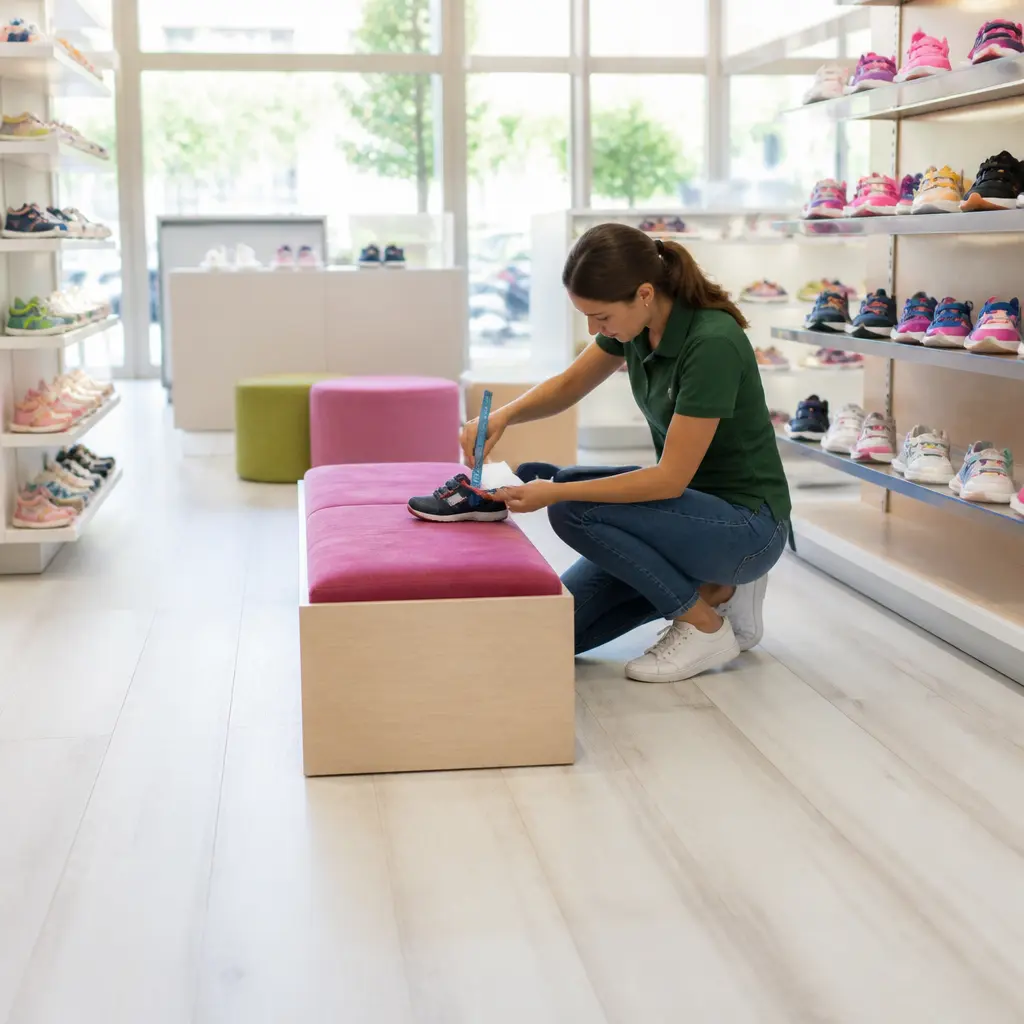
Adjustment should secure the heel without squeezing the forefoot. The American Academy of Pediatrics recommends checking for roughly a thumb’s width of space between the longest toe and the shoe’s front, with enough width for the toes to move freely. Parents should measure both feet because one foot is often slightly larger than the other and should be fitted first.
Roomy Toe Boxes for Natural Movement
A roomy toe box is the front portion of a shoe that allows the toes to spread and bend without pressure. It should provide usable space, not excessive extra length that lets the foot slide forward. Narrow, tapered fronts can press against developing toes, while an appropriately shaped toe box supports balance during walking, running, and climbing.
The American Podiatric Medical Association emphasizes that children’s shoes should fit comfortably immediately; footwear should not be expected to “break in” around painful pressure points. Parents can validate the fit by checking for red marks, curled toes, blisters, slipping heels, or complaints that the shoe feels tight after activity.
Flexible Soles With Stable Heel Support
A flexible sole bends near the ball of the foot, where the foot naturally flexes, while a stable heel counter helps keep the rear of the foot aligned inside the shoe. This combination distinguishes a growth-friendly everyday shoe from a rigid or poorly structured model.
Flexibility does not mean that a shoe should twist freely in every direction. A useful at-home check is to bend the shoe at the forefoot and attempt to twist it gently; excessive twisting may indicate inadequate structure. The Children’s Hospital of Philadelphia similarly advises families to look for flexible soles, secure heel fit, and enough room for the toes when selecting children’s footwear.
These fit attributes lead naturally to the second part of the pairing: shoes must also keep pace with changing schedules. The best design depends on whether the child spends the day moving between school, activities, outdoor play, and transportation.
Match Growing-Foot Shoes to Busy Daily Routines
Everyday Sneakers for School and Play
Everyday sneakers are low-profile athletic shoes intended for repeated walking, classroom use, recess, and informal play. They are usually the most versatile primary pair because cushioning, breathable uppers, rubber outsoles, and adjustable closures can address several parts of a child’s routine.
For school-age children, prioritize a secure fit, a breathable upper, a non-slip outsole, and materials that can tolerate frequent cleaning. Two alternating pairs can be more practical than one pair worn every day because allowing footwear to dry may reduce odor and extend material life. The National Center for Biotechnology Information notes that moisture and friction contribute to common foot problems such as blisters, making socks and ventilation relevant parts of the footwear system.
Slip-On and Hook-and-Loop Shoes for Fast Transitions
Slip-on and hook-and-loop shoes are convenience-focused styles that reduce dressing time. They can work well for preschoolers, children learning independence, and families managing rushed mornings, provided the heel remains secure and the shoe does not depend on a loose fit to stay on.
A fully elastic slip-on may be convenient but can offer less adjustability as foot volume changes. Hook-and-loop closures are often more adaptable because they can accommodate modest changes in instep height and width. Children should practice fastening the shoe so convenience does not come at the expense of a loose or unstable fit.
School Shoes for Uniforms and Indoor Requirements
School shoes are footwear selected to meet uniform policies, indoor-floor requirements, and long periods of walking or standing. The most useful versions combine a simple appearance with the same fit principles as athletic shoes: a broad enough toe box, a flexible forefoot, heel security, and a closure that the child can manage.
Parents should avoid choosing formal-looking shoes that are stiff, pointed, or difficult to fasten merely because they match a uniform. A plain, supportive sneaker may be the safer everyday choice when school rules permit it. If a uniform requires leather or synthetic dress shoes, prioritize flexible construction and inspect the child’s feet after the first several wears.
Sandals for Warm Weather and Water Activities
Children’s sandals are open footwear designed for warm conditions, while water sandals add quick-drying materials and drainage. Closed-toe sandals can provide more protection during playground activities; open-toe styles may offer greater ventilation but leave toes more exposed.
A practical sandal should have an adjustable ankle or heel strap, a contoured footbed, and an outsole with traction. Flip-flops are convenient for brief poolside use but are generally less suitable for extended walking because they provide limited heel control and encourage gripping with the toes. This distinction is especially important when one pair is expected to cover a full day of errands and active play.
Boots for Rain, Snow, and Seasonal Growth
Seasonal boots protect feet from moisture, cold, mud, or snow. A growth-conscious boot should leave space for the intended sock thickness without allowing the heel to lift excessively. Waterproof materials, sealed seams, removable liners, and traction patterns can improve usefulness across changing weather.
Buying boots several sizes too large is not a reliable growth strategy. Excess volume can make walking awkward and increase slipping. Instead, measure with the socks the child will actually wear, check toe clearance while standing, and reassess fit during the season. A removable insole may simplify cleaning and help families monitor how much usable room remains.
Choose Growth-Friendly Features Without Sacrificing Convenience
Durable Materials and Easy-Care Construction
Durable footwear uses materials and stitching that resist the repeated flexing, scuffing, moisture, and abrasion common in children’s routines. Mesh improves airflow, leather and coated synthetics can offer greater abrasion resistance, and rubber outsoles usually tolerate playground contact better than thin casual soles.
Easy-care construction is particularly valuable for busy households. Look for removable insoles, washable or wipeable uppers, quick-drying linings, and color schemes that conceal ordinary dirt. Care instructions matter: machine washing or high heat can distort materials and reduce the useful life of some shoes.
Lightweight Design for All-Day Wear
Lightweight shoes reduce the effort required to lift the feet during repeated walking and running. However, the lightest shoe is not automatically the best shoe; it still needs an outsole that provides traction and an upper that keeps the foot from sliding.
A useful comparison is to assess weight alongside flexibility, stability, ventilation, and closure quality. The American Academy of Pediatrics recommends avoiding heavy or stiff shoes that interfere with normal foot movement, particularly for younger children who are still developing coordination.
Orthotic Compatibility and Medical Considerations
Orthotic-compatible shoes have enough depth and a removable insole to accommodate a prescribed insert without crowding the toes. They should not be confused with shoes marketed as corrective without clinical evidence. Most children do not need special corrective footwear unless a qualified clinician identifies a specific condition.
Persistent pain, limping, repeated blisters, unusual wear, numbness, or frequent tripping warrants professional advice. The American College of Foot and Ankle Surgeons recommends evaluation when children experience ongoing foot or ankle symptoms rather than relying on a larger shoe or an over-the-counter insert to solve the problem.
Use a Practical Fit-Check Schedule for Growing Feet
A fit-check schedule is a routine for measuring children’s feet and inspecting footwear before discomfort develops. The American Academy of Pediatrics advises checking shoe fit frequently because younger children may not recognize or report pressure clearly. A common household practice is to inspect fit every two to three months and whenever the child reports discomfort, although the appropriate interval varies with age and growth rate.
- Measure both feet while the child is standing, preferably late in the day when feet may be slightly larger.
- Use the larger foot to select length and width.
- Check toe clearance, toe movement, heel security, and pressure across the widest part of the foot.
- Repeat the check with the socks, insoles, or orthotics used in daily life.
- Inspect the shoe for compressed cushioning, worn tread, broken closures, and interior seams.
A textual decision chart can simplify the process: choose adjustable sneakers for mixed daily use; choose supportive sandals for warm-weather walking; choose quick-drying water shoes for wet activities; choose boots for weather protection; and choose formal school shoes only when required. In every category, fit and function should come before color, trend, or the promise of extra “growing room.”
Balance Cost, Replacement Cycles, and Foot Health
Growing children may outgrow shoes before the outsole is visibly worn, while active children may wear out the tread before the next size change. The most economical strategy is not always the cheapest purchase; it is selecting a suitable shoe, monitoring fit, caring for materials, and replacing footwear when it becomes too small, unstable, damaged, or uncomfortable.
Families can reduce unnecessary purchases by keeping a small, coordinated rotation: one versatile everyday sneaker, one seasonal or activity-specific pair, and one backup pair when the child’s schedule or weather requires it. This approach supports the broader goal of busy-schedule versatility without asking a single shoe to perform poorly in every environment.
The relevance extends beyond convenience. Ill-fitting footwear can contribute to blisters, pressure, altered walking patterns, and reluctance to participate in physical activity. The Centers for Disease Control and Prevention recommends that children aged 6 through 17 engage in at least 60 minutes of moderate-to-vigorous physical activity daily; comfortable, secure shoes can help remove one avoidable barrier to that activity.
Conclusion: Make Growing-Foot Shoes Work Harder
Growing-foot shoes with busy-schedule versatility combine adjustable fit, a suitable toe box, forefoot flexibility, heel security, durable materials, and activity-appropriate traction. Adjustable sneakers are the strongest general-purpose option; sandals and boots address seasonal needs; school shoes should meet uniform requirements without compromising movement; and slip-on designs can save time when they still secure the heel properly.
Because children’s feet change quickly, shoe selection should be treated as an ongoing process rather than a one-time purchase. Measure both feet, check fit every few months, inspect wear, and replace shoes when comfort or function declines. Families can consult pediatricians, podiatrists, or reputable children’s hospitals for further guidance, particularly when pain, limping, or recurring skin problems appear.
Sources: American Academy of Pediatrics, “Choosing Shoes for Children,” https://www.healthychildren.org/English/ages-stages/gradeschool/fitness/Pages/Choosing-Shoes-for-Children.aspx; American Podiatric Medical Association, “Children’s Foot Health,” https://www.apma.org/foot-health/children; Children’s Hospital of Philadelphia, “Choosing the Right Shoes for Your Child,” https://www.chop.edu/news/health-tip/choosing-right-shoes-your-child; National Center for Biotechnology Information, “Friction Blisters of the Feet,” https://www.ncbi.nlm.nih.gov/books/NBK279519/; American College of Foot and Ankle Surgeons, “Children’s Foot Health,” https://www.foothealthfacts.org/conditions/children-s-foot-health; Centers for Disease Control and Prevention, “Child Activity: An Overview,” https://www.cdc.gov/physical-activity/php/about/index.html