Toddler clothing functionality is the way garments are designed to help young children move comfortably, stay safely dressed, and participate in dressing themselves. Thoughtful choices—such as wide openings, easy-to-grip fasteners, clear front-and-back cues, and comfortable fabrics—can make everyday dressing a practical opportunity to build independence. This matters because self-care skills develop gradually: the U.S. Centers for Disease Control and Prevention (CDC) lists putting on some clothes among the skills many children demonstrate by age 3. Clothing cannot guarantee a milestone, but well-designed garments can reduce avoidable obstacles while supporting comfort, safety, and practice.
Supports toddler clothing functionality for independent dressing
“Independent dressing” is not a single standardized clothing-design term. In this article, it means a toddler’s growing ability to participate in dressing and undressing, from helping with a sleeve to putting on a familiar garment with less assistance. The CDC’s milestone guidance offers a developmental reference—not a deadline or a test—and notes that children develop at different rates. Its milestone checklist says many children can put on some clothes by age 3; the wording “some clothes” is important because mastery of every fastener or outfit is not expected.
A functional garment makes the next step understandable and physically manageable. The relevant design attributes include access, easy-to-operate closures, fit and mobility, sensory comfort, and visual cues. These features are most useful when matched to the child’s current abilities and practiced in a calm routine. The National Association for the Education of Young Children (NAEYC) describes everyday routines as opportunities for children to participate and develop autonomy, while recognizing that adults may need to adapt support to each child.
Developmentally appropriate task steps
Task analysis means breaking a larger activity into smaller actions. Dressing may involve choosing a garment, orienting it, finding an opening, inserting a limb, pulling fabric into place, and managing a closure. A toddler may manage one or two steps before being ready for the rest. Caregivers can let the child complete the achievable part—for example, pulling up elastic-waist pants—then offer help with the remaining steps. This approach connects clothing functionality with graded practice rather than expecting immediate, fully independent dressing.
The CDC’s age-3 clothing milestone provides a useful population-level reference, but it does not specify which garments children should manage or establish a universal sequence. A child’s motor development, experience, disability, clothing type, and setting all affect performance. Persistent concerns about a child’s development are best discussed with a pediatric clinician rather than judged from clothing ability alone.
Access and manageable closures
An accessible garment has openings that allow a child to find and use them without excessive force or precision. Examples include wide neck openings, roomy armholes, pull-on waistbands, and large, easy-to-grasp zipper tabs. These are hyponyms—specific design approaches within the broader category of accessible clothing. A simple pull-on style may suit a child still learning hand coordination, while a large zipper pull may provide a manageable next challenge when an adult starts the zipper.
Closures should be selected for the child’s current skill and the garment’s purpose. Elastic, snaps, buttons, and zippers each demand different hand movements; a small button, for example, typically calls for more precise finger control than pulling a wide waistband. Clothing design guidance from occupational therapy commonly emphasizes adapting the task and environment to make participation possible, but a particular fastener is not universally easiest. Try the garment with the child and consider whether the closure is easy to see, reach, grasp, and release.
Fit, movement, and safety
A functional fit allows movement while keeping fabric and closures from creating avoidable hazards. Toddlers need room to bend, sit, walk, and raise their arms, but oversized garments can bunch or drag and make dressing harder. For sleepwear, follow the garment’s labeling and applicable safety requirements: the U.S. Consumer Product Safety Commission (CPSC) explains that children’s snug-fitting sleepwear is designed to reduce fire risk, while loose-fitting children’s sleepwear is subject to flammability standards. Dressing independence should never be pursued by removing safety protections or using damaged drawstrings and loose parts.
The practical test is both functional and safe: can the child move comfortably, and can the garment be managed without creating a snagging, choking, or trip risk? Check manufacturer instructions, care labels, and current CPSC guidance, especially for sleepwear and garments with cords or small detachable components.
Improves toddler clothing comfort and sensory usability
Clothing comfort is a functional attribute because a child who is distracted or distressed by a garment may find dressing and wearing it more difficult. Comfort involves fabric feel, temperature, seams, tags, fit, and how the garment behaves during movement. These attributes connect the physical design of clothing with a child’s willingness to participate in dressing; they do not imply that every toddler has the same sensory preferences.
Fabric, seams, and temperature
Soft, breathable fabric and smooth seams can make a garment more tolerable for children sensitive to scratchy textures or pressure. Layering can also help caregivers adjust clothing to changing temperatures without requiring a complete outfit change. No single fabric is best for every child: fiber, weave, finishing, laundering, climate, and individual preference all matter. Check for rough labels, stiff seams, tight cuffs, or a waistband that leaves marks, and let the child try familiar alternatives when possible.
Comfort is especially relevant during practice. If a child repeatedly resists one garment, the difficulty may arise from its fit or feel rather than unwillingness to learn. Offering two suitable options can preserve the child’s participation while maintaining adult oversight of weather and activity needs.
Visual cues and garment orientation
Visual cues help a toddler tell the front from the back and locate openings. A small picture, bright waistband, contrasting pocket, or distinctive front motif can make garment orientation more obvious. These cues are a form of visual support: they reduce the number of decisions a child must solve before putting the clothing on. Choose cues that remain visible after washing and do not add detachable pieces that could become a hazard.
A simple routine can reinforce the cue: place the garment with its front facing up, name the feature, and allow the child time to orient it. As the child becomes familiar with the garment, adults can gradually reduce prompts. This links garment design to learning through repetition without treating a mistake—such as putting a shirt on backward—as failure.
Builds independent dressing through practice and caregiver support
Clothing can support skill development, but independence grows through repeated opportunities, encouragement, and appropriately timed assistance. NAEYC’s guidance on developmentally appropriate practice emphasizes responsive teaching that considers a child’s individual development and context. Applied to dressing, this means allowing time for participation, offering manageable choices, and helping only as much as needed.
Use a gradual help sequence
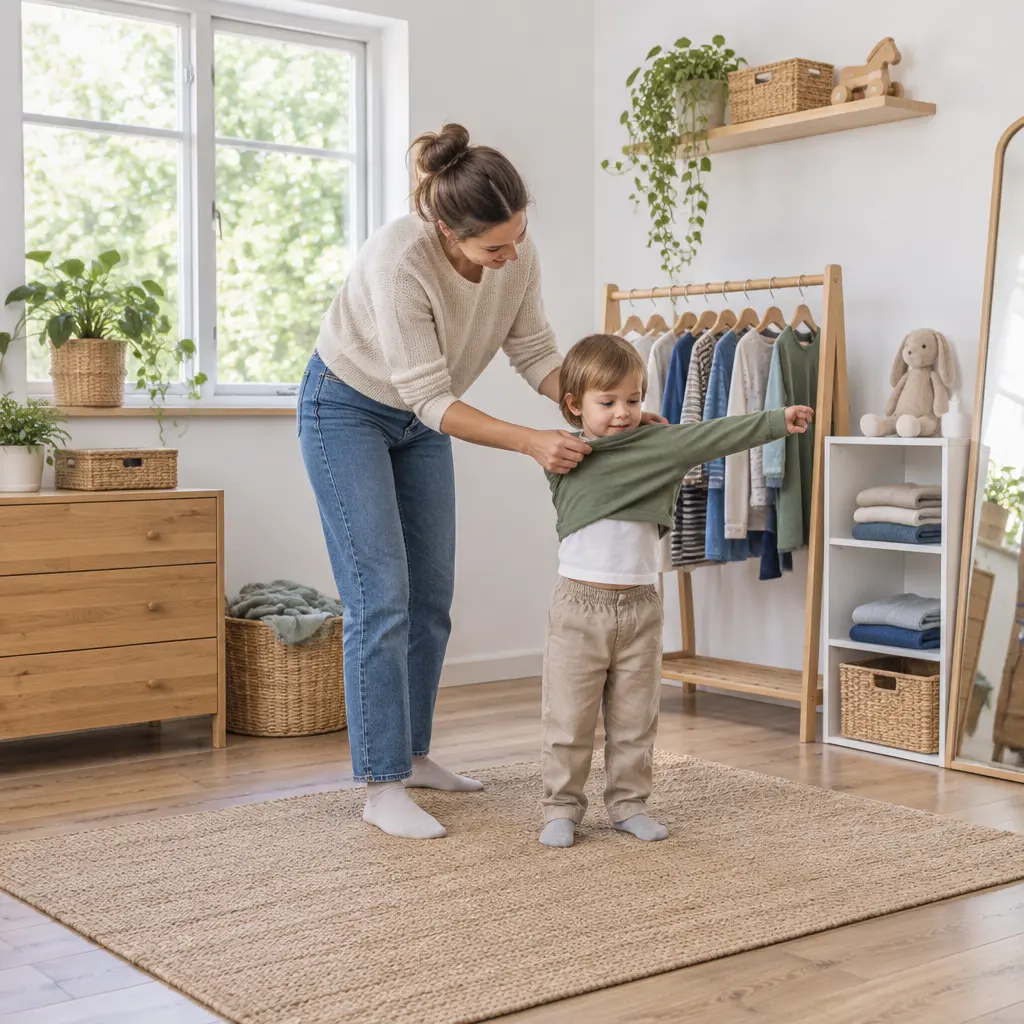
A gradual help sequence starts with the least assistance likely to work and increases support if the child is stuck. A caregiver might first pause, then give a short verbal cue, point to the opening, hold the garment steady, and finally help with the movement. For example, an adult can start a zipper while the toddler pulls the tab. This preserves a meaningful role for the child while avoiding a struggle over a task that is currently too difficult.
Practice is most realistic when it fits the family’s routine. A child can help with one step during ordinary dressing rather than being expected to complete a full outfit under time pressure. If the child becomes frustrated, completing the task and trying again later is a reasonable adjustment.
Choose clothes that match the practice goal
Match the garment to one skill at a time. Pull-on shorts can provide practice with orientation and pulling fabric into place; a roomy shirt can support finding sleeves; and a large zipper pull can offer practice with grasping. A useful progression is to begin with familiar, forgiving garments and introduce a more challenging closure only when the child shows interest and readiness. This is a practical sequence, not a rigid developmental timetable.
- For early participation, choose wide openings, simple shapes, and pull-on waistbands.
- For orientation practice, use a consistent front cue such as a pocket or picture.
- For hand-skill practice, select one easy-to-reach closure and allow the child to try it while seated.
- For comfort, check fabric, seams, temperature, and fit before interpreting resistance as a skill problem.
Applies toddler clothing functionality in everyday settings
The same design feature can work differently at home, childcare, or outdoors. A quick pull-on garment may be useful during toilet routines, while a more protective layer may be needed for outdoor play. The goal is to balance the child’s participation with the demands of the setting, including weather, supervision, time, and safety.
Home and childcare routines
At home or in childcare, a consistent place for dressing and a predictable order can make practice easier to understand. Staff and caregivers can use the same short words for garment parts—such as “tag at the back” or “find the sleeve”—while keeping expectations flexible. In group settings, clothing that is easy to manage can also reduce the time adults spend helping, though supervision and individualized support remain necessary.
For example, a caregiver might offer two weather-appropriate shirts and let the toddler choose, then allow the child to push an arm through each sleeve. The adult can finish the neckline if needed. This combines choice, manageable motor practice, and practical completion of the routine without assuming the child can dress entirely alone.
Accessible clothing and individualized adaptations
Some children benefit from adaptive clothing or individualized modifications because of mobility, dexterity, sensory, or medical needs. Examples include magnetic or hook-and-loop fasteners, side openings, seated-dressing access, and garments designed around medical equipment. These are specialized forms of functional clothing, and suitability depends on the child, the garment, and clinical or caregiver advice. A pediatric occupational therapist can help identify adaptations when dressing is persistently difficult or when a child’s needs are complex.
Adaptation should support dignity and participation rather than impose a single standard of independence. A child may be independent with some steps and need assistance with others; both can be part of successful dressing.
Conclusion: toddler clothing functionality supports participation
Toddler clothing functionality brings together manageable access, safe fit, comfort, visible orientation cues, and opportunities for practice. The CDC’s milestone guidance notes that many children put on some clothes by age 3, while development and clothing demands vary. Design can make participation easier, but it cannot replace responsive adult support or establish a timetable that fits every child.
Caregivers and designers can start with simple openings, comfortable fabrics, clear garment cues, and one achievable dressing step at a time. Observe what the child can do, adapt the garment and routine, and consult a pediatric professional when persistent difficulty raises developmental or access concerns. For further guidance, review CDC developmental milestone resources, NAEYC materials on developmentally appropriate practice, and CPSC clothing safety guidance.
Sources: Centers for Disease Control and Prevention, “Important Milestones: Your Child By Three Years,” https://www.cdc.gov/ncbddd/actearly/milestones/milestones-3yr.html; National Association for the Education of Young Children, “Developmentally Appropriate Practice,” https://www.naeyc.org/resources/position-statements/dap; U.S. Consumer Product Safety Commission, “Children’s Sleepwear,” https://www.cpsc.gov/Business–Manufacturing/Business-Education/Business-Guidance/Childrens-Sleepwear