Family fashion coordination is the practice of choosing clothing that creates a coherent look across relatives while preserving each person’s individual style. Rather than dressing everyone in identical outfits, families can build visual harmony through a shared palette, complementary patterns, similar levels of formality, or coordinated accessories. This approach matters because clothing communicates identity and belonging: research published in the Journal of Experimental Social Psychology found that clothing can influence how people perceive wearers, while family photographs and celebrations make coordinated choices especially visible. A practical plan balances color, occasion, comfort, age, and personal preference—without requiring a uniform.
Creates visual harmony through a shared family fashion palette
A shared palette is a set of colors chosen to work together across several outfits. In family fashion coordination, it does not mean every person wears the same color; it means outfit colors relate through repetition, contrast, or common undertones. Color theorist Johannes Itten’s work on color relationships describes how hues can create harmony through complementary, analogous, and contrasting arrangements. Applied to clothing, a family might combine navy, cream, and rust, then let each person choose which shade or combination suits them.
Palette coordination is useful for portraits, holidays, weddings, and travel because it gives a group a recognizable visual connection without making individual outfits interchangeable. The U.S. Census Bureau’s American Community Survey counted more than 333 million people in the United States in 2022, reflecting the broad range of household sizes and family arrangements that styling advice needs to accommodate. A flexible palette works for multigenerational groups, blended families, and relatives with different preferences.
Choose a palette with shared color anchors
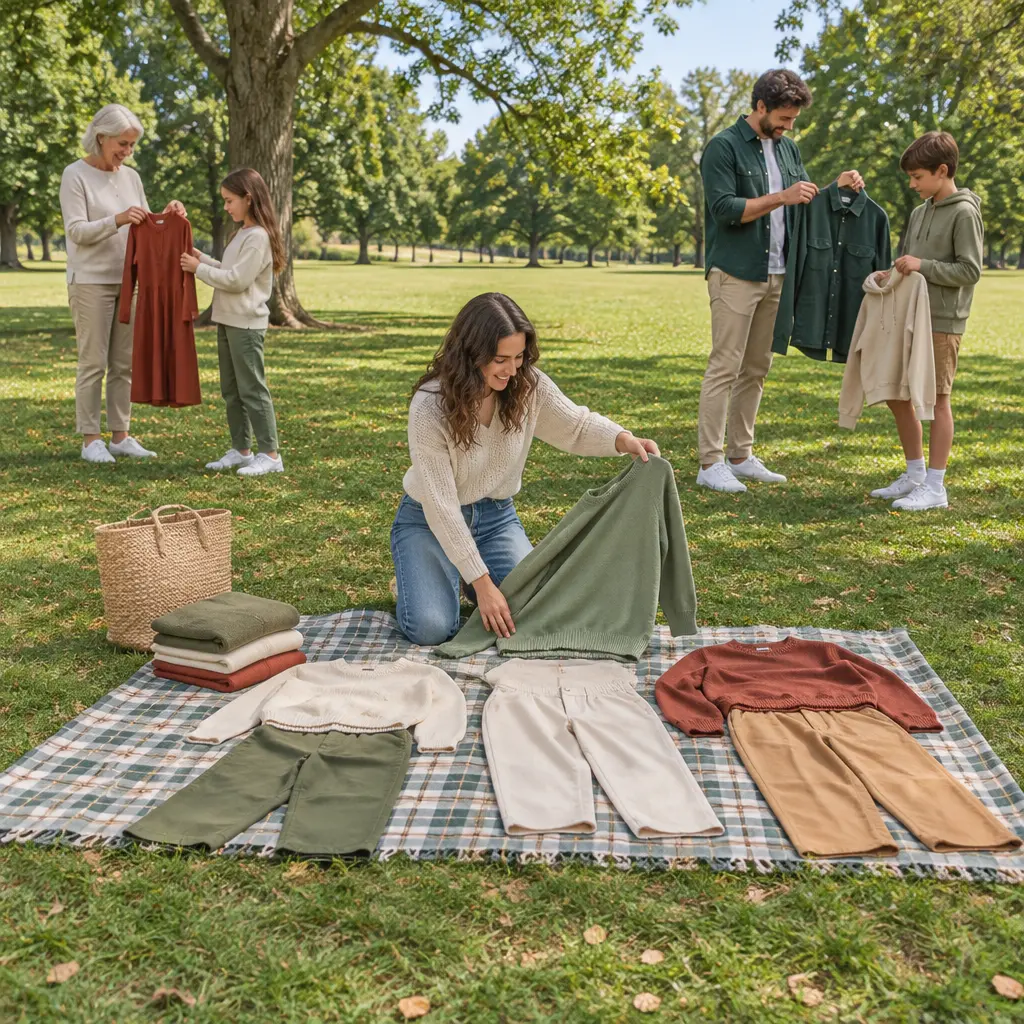
A color anchor is a recurring shade that links outfits, such as denim blue, forest green, or warm beige. Select two or three main colors, then add a neutral such as white, charcoal, or tan. For example, one person could wear a green dress, another a cream shirt with green trousers, and a child a patterned outfit that includes both colors. This creates connection through color rather than identical garments.
Color choices should also account for the setting and lighting. The Smithsonian’s National Portrait Gallery notes that portrait backgrounds and clothing contribute to the visual reading of an image. For outdoor photographs, earthy or muted colors often sit comfortably within natural surroundings; for a formal indoor event, deeper shades and refined neutrals may suit the atmosphere. These are styling choices, not fixed rules, so the palette should reflect the family and occasion.
Use contrast and pattern selectively
Contrast helps a coordinated group avoid looking flat. A light garment can balance darker outfits, while a print can introduce several shared colors at once. Keep patterns at different scales—for instance, one large floral, one small check, and several solid pieces—to reduce visual competition. If multiple people wear prints, repeat at least one color across them so the patterns feel connected.
This approach is particularly effective in photographs, where repeated shapes and colors can guide the eye. It is not necessary to ban logos or prints; instead, consider whether a prominent graphic distracts from the group or fits the occasion. A simple check before dressing is to place the outfits together and look for a balanced distribution of light, dark, solid, and patterned pieces.
Builds coordinated outfits through silhouette, occasion, and comfort
Outfit coordination extends beyond color. Silhouette, fabric, formality, and practicality determine whether the group looks intentional and feels comfortable. The American Psychological Association’s research literature on clothing and social perception discusses how attire can shape impressions in context, including judgments of professionalism and role. For families, the same principle supports dressing appropriately for the event while allowing each person to express a distinct personality.
The best coordinated look accounts for the event’s demands. A beach gathering may call for breathable fabrics and easy footwear, while a ceremony may require more structured clothing. Matching the level of formality is often more important than matching garment types: a child in a comfortable dress shirt and trousers can look cohesive beside adults in relaxed, polished outfits without wearing an exact copy of anyone else’s clothes.
Match formality, not exact garments
Formality coordination means choosing clothes of a similar dress level. For a casual family session, that could mean knitwear, denim, and clean sneakers; for a formal celebration, it could mean suits, dresses, or tailored separates. The goal is to avoid one person appearing ready for a gala while another looks dressed for exercise, unless that contrast is intentional.
The U.S. Bureau of Labor Statistics’ American Time Use Survey documents how time spent on activities varies across age and household circumstances. While it does not prescribe clothing, it reinforces a practical point: family members have different daily routines and needs. A coordinated outfit should accommodate movement, caregiving, mobility aids, temperature, and children’s comfort rather than prioritize appearance alone.
Balance silhouettes and textures
Silhouette refers to the overall outline of clothing, while texture describes the surface or feel of a fabric. Families can create cohesion by repeating a broad shape—such as relaxed layers—or a texture, such as denim, knitwear, or linen, without dressing alike. Mixing textures adds depth: a smooth cotton shirt can sit alongside a knitted cardigan and a lightly textured skirt.
Consider how clothing looks when people stand or sit together. Very voluminous garments on everyone can obscure individual shapes in a group portrait, while outfits with varied proportions often create a more balanced composition. Comfort remains central: the U.S. Centers for Disease Control and Prevention advises choosing clothing appropriate to weather conditions, including layers in cold settings. For outdoor events, planning for temperature and movement is part of successful coordination, not an afterthought.
Preserves personal identity through inclusive family styling
Inclusive family styling recognizes that relatives may differ in age, body shape, gender expression, cultural background, sensory needs, and personal taste. Visual harmony should be an invitation, not a dress code that removes those differences. A family can share a color story or accessory while allowing each person to select garments that feel authentic and appropriate to them.
This matters because clothing is both practical and expressive. The Smithsonian’s National Museum of African American History and Culture, for example, documents how dress can express cultural identity, community, and historical experience. Family coordination should therefore make room for meaningful clothing choices, including cultural garments, religious attire, and heirloom accessories, rather than treating uniformity as the measure of success.
Offer choices for different ages and preferences
A choice-based plan gives each person options within the shared concept. Parents might agree on a palette and occasion level, then let each relative select a preferred outfit. Children can choose between two comfortable options; adults can decide whether they prefer a dress, trousers, or a skirt. This reduces last-minute disagreements and helps everyone feel included in the final look.
For sensory-sensitive family members, prioritize familiar fabrics, soft seams, adjustable layers, and footwear they can tolerate. For older relatives or anyone with mobility needs, ease of dressing and freedom of movement may be more important than a particular silhouette. Coordination can come from color or accessories, so no one needs to sacrifice comfort to participate.
Include cultural and personal details with care
Accessories can connect outfits while carrying individual meaning. A shared metal tone, family tartan, scarf color, or small floral motif can tie a group together, while each person chooses how to incorporate it. If a family includes traditional clothing or garments associated with a ceremony, build the broader palette around those pieces rather than asking someone to alter or replace them.
A useful real-world example is a multigenerational portrait in which one relative wears a traditional garment with strong colors. Others can echo one or two of those colors in shirts, dresses, or accessories. The result acknowledges the garment as a central part of the family story and creates visual continuity without making everyone wear the same cultural or formal attire.
Applies family fashion coordination to photos, events, and everyday life
The right coordination strategy depends on where and why the family is dressing together. A planned portrait benefits from deliberate color distribution, while everyday coordination works best when it is easy to repeat with clothes people already own. The Ellen MacArthur Foundation has reported that the global fashion system produces substantial environmental impacts and has promoted circular approaches such as reuse, repair, and longer garment use. Choosing existing clothing before buying new outfits can make coordinated dressing more economical and less wasteful.
A simple planning process is to identify the event, choose a palette, check each person’s comfort needs, and lay the outfits together before the day. If the group looks too similar, vary pattern, silhouette, or shade. If it looks disconnected, repeat a color or texture. The aim is a shared visual idea that remains adaptable.
Coordinate for family portraits
For portraits, begin with the location and background. Natural settings often pair well with muted greens, blues, creams, and earth tones, while urban or studio backgrounds can support stronger contrast. Avoid placing everyone in a single bright color unless that is the deliberate concept; instead, distribute color across the group. Check that clothing allows people to sit, hold children, and move naturally.
A practical example is a family of five choosing denim blue, rust, and ivory. One adult wears a blue shirt, another a rust cardigan, and the children wear outfits that combine ivory with one of the anchor shades. A small print can repeat the palette without becoming the main focus. The photographer’s guidance on location and lighting can refine the choices further.
Coordinate for celebrations and travel
For celebrations, let the event’s dress code lead. Weddings may require formal attire and respect for the couple’s color guidance; holidays may invite seasonal colors without requiring novelty garments. For travel, prioritize versatile pieces that layer, resist wrinkling where useful, and work across activities. A coordinated capsule—several tops and bottoms in compatible colors—can create multiple outfits from fewer items.
Before buying anything, check wardrobes for suitable pieces and consider borrowing, renting, or rewearing. The U.S. Environmental Protection Agency’s reports on municipal solid waste identify textiles as part of the broader waste stream, underscoring the value of extending garment life. Buying a new matching set for a single photograph is rarely necessary when color, styling, and accessories can bring existing clothes together.
Conclusion: Family fashion coordination makes belonging visible without erasing individuality
Family fashion coordination works best when a shared palette, compatible formality, balanced silhouettes, and practical comfort guide the choices. These elements create visual harmony while preserving personal identity, cultural expression, and age-appropriate preferences. For portraits, celebrations, travel, or daily life, coordination can be simple: choose a few common colors, invite individual outfit choices, and make sure everyone can move comfortably.
The broader lesson is that a coordinated appearance does not require uniformity or new purchases. Start with clothes family members already own, identify one connecting detail, and adapt the plan to the occasion and each person’s needs. For further reading, consult the cited resources on clothing and perception, color relationships, portraiture, and sustainable fashion before planning your next family look.
Sources: Itten, Johannes, The Art of Color: The Subjective Experience and Objective Rationale of Color, 1961, https://www.wiley.com/en-us/The+Art+of+Color%3A+The+Subjective+Experience+and+Objective+Rationale+of+Color-p-9780471289296; U.S. Census Bureau, American Community Survey, 2022, https://www.census.gov/programs-surveys/acs; U.S. Bureau of Labor Statistics, American Time Use Survey, https://www.bls.gov/tus/; U.S. Centers for Disease Control and Prevention, Cold Stress, https://www.cdc.gov/niosh/cold-stress/about/; Smithsonian National Portrait Gallery, Portraits and the Art of Seeing, https://npg.si.edu/; Smithsonian National Museum of African American History and Culture, Fashion and Dress, https://nmaahc.si.edu/; Ellen MacArthur Foundation, A New Textiles Economy: Redesigning Fashion’s Future, 2017, https://ellenmacarthurfoundation.org/a-new-textiles-economy; U.S. Environmental Protection Agency, Textiles: Material-Specific Data, https://www.epa.gov/facts-and-figures-about-materials-waste-and-recycling/textiles-material-specific-data.